

Caring for Crocodile Leather
How to keep a crocodile or alligator leather jacket supple, glossy and unmarked for a lifetime — the routine we give every client.
1 July 2026 · 2 min read
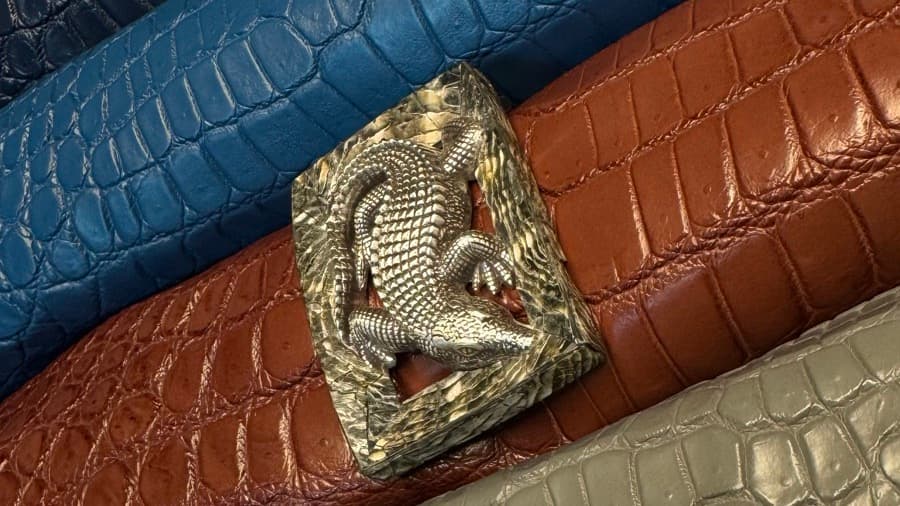
Crocodile leather is not delicate, but it is particular. Worn and kept well, an exotic hide only improves — the colour settles, the shine deepens, the scales take on the shape of the person wearing them. Left to dry out, the same hide stiffens and lifts along the scale edges. What follows is the exact routine we hand to every client who commissions a piece from our Istanbul atelier; it takes minutes a season and it is the difference between a jacket that lasts ten years and one that lasts fifty.
Heat is the enemy, not water
People panic about rain. Rain is fine. Blot the piece with a soft cloth and let it dry on its own, in the room, at room temperature — never on a radiator, never under a hairdryer, never in a hot car. Forced heat drives the natural oils out of the skin, and once a hide has gone brittle there is no putting them back. Give it a broad wooden hanger and a day, and it comes back exactly as it was.
Feed it two or three times a year
Exotic leather wants feeding, not drowning. A conditioner made for reptile hides, a soft cloth, thin coats worked along the direction of the scales, then buffed off after a few minutes — that is the whole job. Twice a year is plenty for a piece worn now and then; three times if you wear it often or live somewhere dry. New product always goes on an inside seam first, never the front panel.
- Use a conditioner made for exotic or reptile leather — never household oils, saddle soap or anything petroleum-based.
- Thin coats, buffed back. A heavy coat sits in the grain and kills the shine you are trying to keep.
- Always work head-to-tail, with the scales, never against them.
Store it with room to breathe
Hang it wide, keep it cool, let it breathe. A breathable garment bag is right; plastic is wrong, because it traps moisture against the skin. And do not wedge it between two winter coats — that is how a scale gets crushed flat and never quite recovers. A hand's width of space on either side is all it asks.
A crocodile hide will outlast its owner — if it is kept dry, fed lightly, and never rushed.
When to bring it back to us
A scale that has lifted, a seam that has loosened, a scuff that will not buff away — these belong with the maker, not a high-street repair shop. Because every piece we make is signed and numbered, we keep its record, and we can put it right in the same hands that built it. If you are still deciding on a piece, it is worth knowing how crocodile, alligator and caiman differ before you commission, or you can simply browse the current jackets and message us.
Related reading
Commission a piece in the same hands.
Every POSSORRE piece is handmade to order, signed and numbered.
Explore the collection